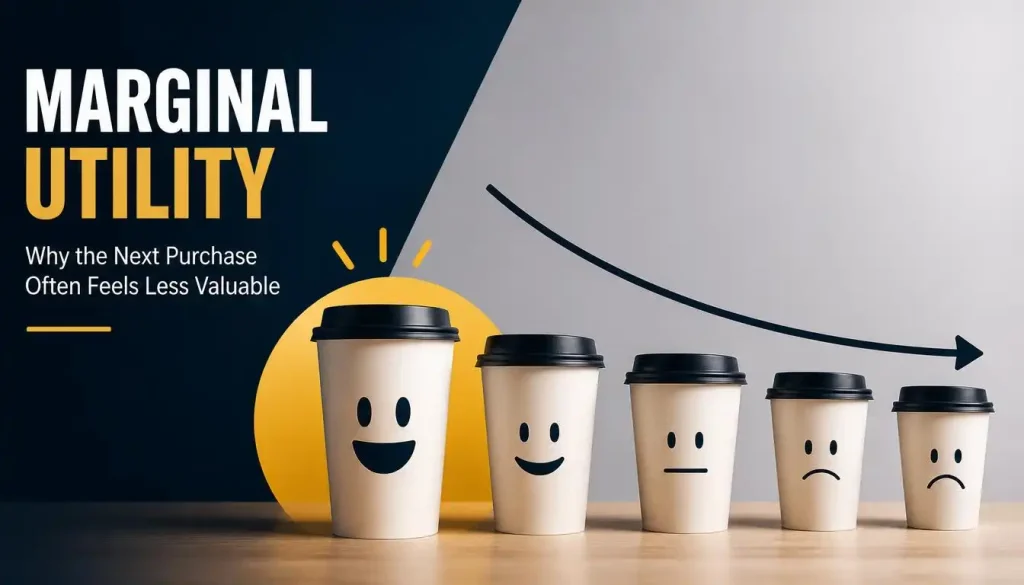
The first coffee and the third coffee may provide very different amounts of enjoyment. Marginal utility describes the additional satisfaction from consuming one more unit. It is narrower than marginal benefit, which can describe the incremental advantage of many kinds of decisions.
Total utility can rise while marginal utility falls
For a teaching example, assign total utility of 10, 17 and 21 to one, two and three coffees. The marginal contributions are 10, 7 and 4. The third coffee adds less than the second but still adds something: total utility continues to rise. A smaller increment does not immediately mean a falling total.
These numbers are hypothetical teaching devices, not scientifically measured happiness scores. They do not imply that satisfaction can be measured precisely on the same scale across different people.
Price introduces an alternative use of money
Still enjoying another coffee does not mean being willing to pay any price for it. Money spent on the third cup cannot also buy a snack or meet another need. The relevant comparison includes the next-best use of the budget, not just the enjoyment of previous cups.
A bundle can therefore lower unit cost without saving you money. If one coffee costs 5 and three cost 12, the per-cup price falls. But someone who really wants only one spends 7 more by buying the bundle. Extra consumption with little value does not become a saving merely because the unit price is lower.
Context matters
A morning coffee and a coffee after a sleepless night do not represent identical circumstances. Need, timing and available alternatives change the extra satisfaction. To understand the basic concept, compare successive units under broadly similar conditions.
Marginal utility makes a useful purchasing question explicit: what does one more actually add for me? The answer comes from the next unit’s contribution, not simply from owning or consuming a larger total.
The First Unit and the Tenth Unit Are Not the Same Decision
Marginal utility asks about the additional satisfaction created by one more unit, not the total usefulness of everything already consumed. The first glass of water after a long walk can be extremely valuable. The fifth glass may add very little. Total utility can still be high even while the utility of the next unit is falling. This distinction is central because many everyday choices are made at the margin: one more coffee, one more streaming subscription, one more hour of leisure or one more unit of savings.
The concept does not claim that every repeated purchase becomes worthless. It says that, holding other conditions broadly constant, the extra benefit from another similar unit often declines after earlier needs have already been satisfied. That is why the decision to buy the next unit can differ from the decision that justified the first one.
Diminishing Marginal Utility Is a Pattern, Not a Universal Law
The familiar textbook pattern is diminishing marginal utility: each additional unit gives less incremental satisfaction than the one before it. Yet real life can produce exceptions. A collector may value the final item needed to complete a set more than an earlier item. Network effects can make an additional user or device more useful when it connects to an existing system. Skills can also have threshold effects, where another lesson suddenly unlocks a new ability.
The practical lesson is to use diminishing marginal utility as a way to examine choices, not as a rigid prediction about every person and product. Preferences, scarcity, context and timing can change the shape of the utility gained from the next unit.
Why Price Matters at the Margin
A consumer does not compare utility in isolation. The relevant question is whether the benefit of the next unit is worth its price and the opportunity cost of the money used. A second pair of similar shoes may still be useful, but if its added benefit is small relative to the price, the same money could produce more value elsewhere.
Economists often express this intuition by comparing marginal utility per unit of price across alternatives. In a simplified model, a household allocates spending until the extra satisfaction obtained from the last unit of money spent is roughly balanced across uses. Real people do not perform formal calculations, but the logic helps explain why spending shifts when prices change.
Opportunity Cost Turns Utility Into a Budget Decision
Every purchase excludes another use of the same money. Spending 100 on a meal means that 100 cannot simultaneously fund savings, transport, a book or debt repayment. The relevant comparison is therefore not ‘Do I like this?’ but ‘Is the added benefit of this next purchase greater than what I give up?’
This is especially useful for discretionary spending. A product can be enjoyable and still be a poor marginal choice if the next best alternative is more important. Thinking in terms of opportunity cost prevents the false choice between ‘valuable’ and ‘worthless’; many financial decisions involve choosing between two valuable uses of limited resources.
Marginal Utility Helps Explain Demand Curves
One reason demand curves often slope downward is that consumers generally require a lower price to buy additional units once the highest-priority uses have already been satisfied. The first unit may serve an essential purpose, while later units serve progressively less urgent purposes. A lower price makes those lower-value uses worthwhile.
This is not the only force behind demand, but it provides an intuitive microeconomic explanation. When a product becomes cheaper, consumers can justify uses that previously did not pass the cost-benefit test. When it becomes more expensive, they cut the least valuable units first.
Income Changes the Meaning of the Same Price
The utility of spending is also influenced by the household’s income and financial position. One hundred units of currency can have very different practical significance for a family with little disposable income and for a wealthy household. The purchase price is identical, but the opportunity cost is not.
This is one reason marginal utility of money is often assumed to decline as wealth rises. An extra 1,000 may transform the month for someone facing rent pressure, while the same amount may barely change consumption for someone with substantial savings. The idea is useful in personal finance because it highlights why emergency cash has unusually high value when liquidity is scarce.
Subscriptions Create a Useful Marginal-Utility Test
Subscription businesses make repeated marginal decisions easy to overlook. The first streaming service may replace expensive entertainment and provide high value. The fourth or fifth service may be used only occasionally. Because the charges are automatic, the customer may stop comparing the next month’s benefit with the next month’s price.
A useful review asks how much the service was actually used during the last billing cycle, what would be lost if it were cancelled and whether a cheaper substitute exists. The question is not whether the service has any value; it is whether the next payment still produces enough incremental value.
Bulk Discounts Can Conflict With Diminishing Usefulness
Buying a larger pack can reduce the price per unit, but the lower unit price does not guarantee a better economic outcome. If half the product expires, sits unused or encourages consumption that would not otherwise occur, the marginal utility of the extra quantity may be below even the discounted price.
The correct comparison therefore combines unit cost with likely use. A warehouse-size purchase is attractive when consumption is predictable and storage is cheap. It can be wasteful when the extra quantity has little value after the immediate need is met.
Sunk Costs Should Not Raise the Utility of the Next Unit
Past spending is already gone. If a gym membership was prepaid, that cost should not make an additional hour at the gym more valuable than it really is today. Likewise, money already spent on a hobby should not justify another purchase when the next item provides little benefit.
Marginal analysis deliberately focuses on future costs and future benefits. This helps separate rational continuation from the psychological desire to ‘get our money’s worth.’ A sunk cost may explain how we arrived at the current position, but it should not automatically determine the next decision.
Marginal Utility and Saving Compete for the Same Money
Saving can be understood as purchasing future flexibility. The marginal utility of another unit of current consumption should therefore be compared with the value of additional liquidity, debt reduction or future spending power. When an emergency fund is nearly empty, the next amount saved may have high utility because it protects against late fees, forced borrowing or missed obligations.
As reserves become large relative to likely short-term needs, the marginal value of another unit of idle cash may fall, and investment or other goals can become more attractive. This does not create a universal savings level; it shows why the best use of the next dollar can change as the balance sheet changes.
Businesses Use the Same Logic in Product and Pricing Decisions
Marginal utility is not only a consumer concept. Businesses study how customers value upgrades, larger package sizes and additional features. If buyers place little value on the fifth feature, adding it may increase production cost without supporting a higher price. Conversely, one carefully chosen feature can have high incremental value for a target segment.
Pricing tiers often exploit differences in marginal willingness to pay. A basic plan satisfies core needs, while premium tiers bundle features that are highly valuable to a smaller group. Understanding where incremental customer value falls helps firms avoid overengineering products.
A Practical Marginal-Utility Audit for Spending
For a discretionary purchase, first identify the exact unit being considered: the first item, a replacement or an additional duplicate. Then ask what new problem it solves, how often it will be used, what cheaper substitute exists and what the same money could accomplish elsewhere. Finally, compare the incremental benefit with the incremental cost rather than comparing the purchase with having nothing at all.
This framework is especially useful when marketing creates urgency. Limited-time discounts, loyalty points and bundles can make the total deal look attractive while hiding the weak value of the extra unit. The disciplined question remains simple: what does the next unit add to my life relative to what it costs?