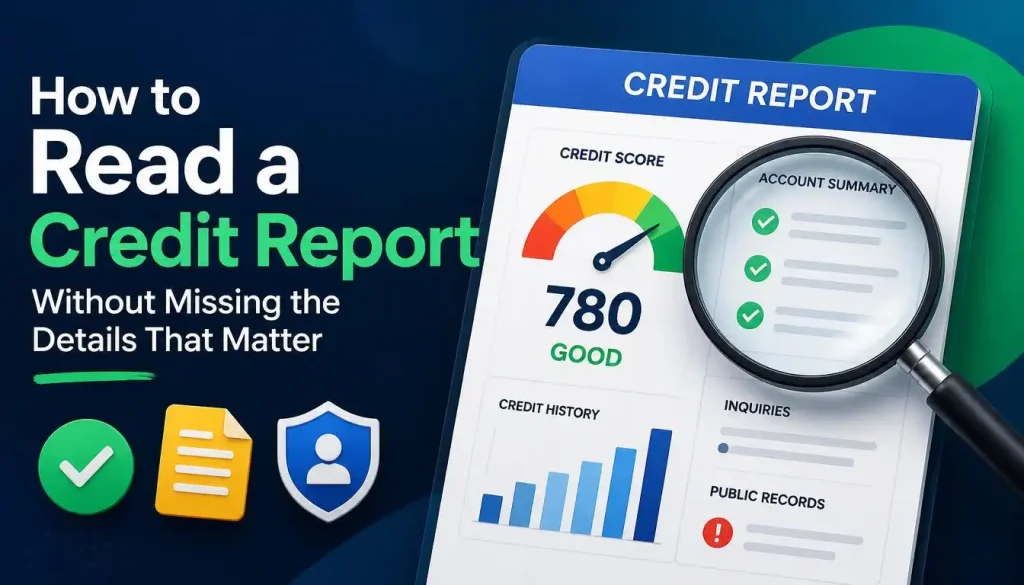
Reading a credit report means more than checking the headline score. To find an error, work through accounts and dates systematically. The task is to distinguish accurate information, reporting delays and records that do not belong to you.
First pass: identity and ownership
Check identifying details, then ask whether you recognise each account. An unfamiliar creditor name is not automatic proof of fraud: a debt transfer or different trading name may explain it. Nevertheless, do not accept an unexplained account without clarification.
Second pass: status and dates
Is the account open or closed? What date does the reported balance cover? Which months are marked late? Is one obligation duplicated, or do separate entries describe different aspects of it? Answer these questions individually rather than reacting only to the total balance.
A loan settled on 15 September may appear open in information dated 31 August. That may be a reporting delay. An unexplained balance dated 30 September needs a different investigation using the settlement evidence. Align dates before concluding that the report is wrong.
Third pass: supporting documents
For a changed limit, locate the lender’s effective date. For a disputed late payment, identify both the payment instruction date and the date it reached the account. Match statements, receipts and closure confirmations to the relevant entry. Explaining exactly which field is wrong is more useful than a general assertion that the whole report is incorrect.
Make the dispute traceable
Use the reporting organisation’s and information provider’s official channels as applicable locally. Keep the reference number, documents and response. Review the next report to see whether an agreed correction actually appears. Disliking an accurate adverse entry does not make it erroneous: a dispute should concern accuracy. Redact unnecessary identifying and account details when sharing a report for advice.
Start With Identity Information Before Looking at Scores
A credit report begins with identifying information such as name variations, addresses, dates or other identifiers used by the local credit system. These fields do not usually affect the score directly, but mistakes can signal that records from another person have been mixed into the file. An unfamiliar address can also be an early clue of identity theft or an old account that should be investigated.
Reviewing identity data first creates a clean foundation for the rest of the report. A person who jumps directly to the score can miss a duplicate profile or a fraudulent account that explains the number.
Account Status Matters More Than the Account Name
Each credit account usually shows the lender, account type, opening date, credit limit or original balance, current balance, payment status and sometimes payment history. The most important task is to understand whether the account is open, closed, current, late, charged off or in collection.
A closed account is not automatically negative, and an open account is not automatically positive. The useful question is whether the history accurately reflects what happened and whether the current status matches reality.
Read the Payment History as a Timeline
Many reports show monthly symbols or codes indicating whether payments were on time, 30 days late, 60 days late or worse. One isolated late payment can be important, but a pattern of repeated delinquencies usually tells a stronger story about risk.
Check both the date and the severity. A late-payment notation from years ago is different from one reported last month. If the account has been current for a long period after an old problem, that recent positive history adds context even though the old mark may still remain.
Balances and Limits Reveal Utilization
For revolving accounts such as credit cards, compare the reported balance with the reported limit. A balance of 8,000 on a 10,000 limit means 80 percent utilization on that account. High utilization can weaken a profile even if every payment is made on time.
Remember that the reported balance may not equal today’s balance. Lenders usually report on a schedule, so a card paid yesterday can still show last month’s figure. Look for persistent patterns rather than treating one snapshot as a complete picture.
Installment Debt Should Be Read Differently
An installment loan has an original amount and a declining balance rather than a reusable credit limit. A mortgage, auto loan or personal loan can therefore show a large balance without the same utilization interpretation used for a credit card.
Focus on whether payments are current, how much of the original balance remains, and whether the account terms match your records. A new installment loan can increase total debt while also building payment history if managed well.
Hard Inquiries Show Recent Demand for Credit
A report may list inquiries from lenders after credit applications. These are often called hard inquiries. One inquiry is usually not a crisis, but many unrelated inquiries in a short period can signal that the borrower is seeking a large amount of new credit.
Separate lender inquiries from soft inquiries such as your own report check or pre-screening where the local system distinguishes them. The exact scoring treatment varies, so the report should be read according to the rules of the relevant bureau.
Collections and Public Records Need Immediate Attention
Collection accounts, defaults, court-related records or other severe negative items can have a major effect on lending decisions. Verify the creditor, amount, dates and whether the debt belongs to you. If the obligation was paid or settled, check whether the status was updated correctly.
Do not assume that paying a collection instantly removes the history. Reporting rules differ by jurisdiction. The first objective is accuracy; the second is understanding how the current lender or scoring model treats the record.
Look for Duplicate Debts
The same obligation can sometimes appear more than once, especially after a debt is transferred or sold to a collection agency. A legitimate transfer may create multiple references, but the balances and statuses should not imply that you owe the same amount twice.
Duplicate reporting can distort how a human underwriter views the file and may affect automated systems. Compare account numbers, dates, original creditor information and current owner of the debt.
Closed Accounts Can Still Tell a Useful Story
Older closed accounts may remain on the report for a period and can provide evidence of long payment history. Their presence is not necessarily a problem. What matters is whether the closure reason and payment status are accurate.
If an account was closed by the lender after serious delinquency, that is different from a consumer closing an unused card in good standing. The report details should make the distinction clear.
Compare the Report With Your Own Records
Bank statements, loan statements, payoff letters and account-closure confirmations are valuable when something looks wrong. A credit report is a data product assembled from information supplied by others; it is not infallible.
When disputing an error, specific documentation is stronger than a general statement that the score is unfair. Identify the exact account, field, amount or date you believe is incorrect and keep a record of the dispute.
Watch for Signs of Identity Theft
Unknown accounts, addresses you never used, inquiries you did not authorize or sudden balances on dormant accounts can indicate fraud. One unusual item does not prove identity theft, but it deserves prompt investigation.
If fraud is suspected, follow the local process for freezing or protecting the file, contact the relevant lender and document every step. Speed matters because new fraudulent accounts can generate additional inquiries, balances and missed payments.
Do Not Read the Score Without Reading the Reasons
If the service provides reason codes or explanatory factors, they can be more actionable than the headline score. A lower score caused by high card utilization needs a different response from a lower score caused by a recent default.
Reason codes are not a complete formula, but they help prioritize. Paying down a card may address utilization; it will not erase an accurate serious delinquency. The remedy should match the underlying factor.
Check the Report Before a Major Credit Application
Reviewing the file several weeks or months before applying for a mortgage, auto loan or business-related personal guarantee gives time to correct errors and reduce avoidable balances. Waiting until the lender has already declined the application leaves less room to act.
Do not open unnecessary new accounts during this preparation period simply to ‘improve the score.’ Stability, lower revolving balances and accurate records are usually more useful than last-minute complexity.
A Repeatable Credit-Report Review Routine
Read the report in the same order each time: identity information, open accounts, closed accounts, payment history, balances and limits, inquiries, collections or public records, then dispute status. Mark every item as confirmed, needs explanation or needs correction.
Review frequency depends on the local system and your circumstances, but a periodic check is valuable even when you are not borrowing. The purpose is not to obsess over the score; it is to make sure the underlying record accurately describes your financial behavior.
A Simple Review Example
Imagine a report with three cards and one personal loan. Card A has a 10,000 limit and 1,000 balance, Card B has a 5,000 limit and 4,500 balance, and Card C has a zero balance. Total utilization is 5,500 out of 15,000, or about 37 percent, but Card B alone is at 90 percent. A reader who looks only at the total ratio can miss the concentration on one account.
Now add a 60-day late payment on the personal loan from two months ago. That recent delinquency is likely more important than an old closed card with perfect history. Reading the report means ranking the significance of each item rather than treating every line equally.