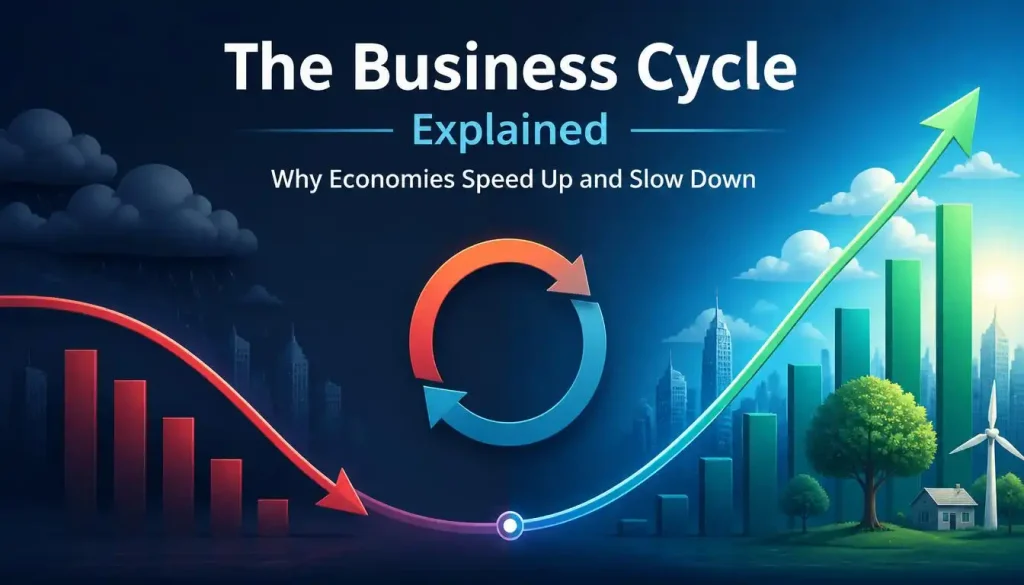
Economic activity does not grow at a constant speed. Production, employment and spending can strengthen, slow or decline over extended periods. The business cycle describes these broad movements; it is not a clock with fixed intervals.
Distinguish levels from growth rates
If an output index rises from 100 to 105 and then 107, the economy is still growing in the second period, only more slowly. A fall from 107 to 103 is a decline in the level of output. Confusing a slowdown with a contraction can distort the meaning of economic headlines.
An expansion runs from a trough toward a peak; a contraction moves from a peak toward a trough. Turning points often become clear only later. Recession definitions and dating practices vary across countries, so a two-quarter rule is not a universal complete test.
How a fall in orders spreads
A manufacturer seeing weaker orders may cut overtime. Its supplier then receives fewer orders and postpones investment. Changes in wages and expectations can affect household spending. This chain illustrates how weakness can spread beyond one company or sector, without implying every shock produces an equally large downturn.
Recovery is uneven
Production can recover before hiring because firms first use idle capacity or existing employees more intensively. Employment may therefore lag output. Share prices also reflect expectations about the future, so they need not move alongside today’s economic statistics.
Read real output, employment, income, sales and credit conditions together. One strong release does not prove a durable expansion, and one weak release does not establish an economy-wide contraction. For a business, the practical purpose is often to understand how changing demand affects inventory, capacity and cash requirements rather than predict the exact month of the next peak.
The Cycle Is About Broad Activity, Not One Indicator
Economists use many data series because no single indicator captures the whole economy. Real GDP, industrial production, employment, retail sales, personal income, business surveys and credit conditions can move at different times. A business cycle refers to the broad pattern across activity, not to one monthly release.
This is why a weak manufacturing survey does not automatically mean the entire economy is in recession, and strong payroll growth does not guarantee that every sector is healthy. The more indicators point in the same direction, the stronger the signal.
Expansion Usually Builds Through Income, Spending and Confidence
During an expansion, employment and incomes often rise, households spend more, businesses increase production and investment, and credit losses remain manageable. These forces can reinforce one another: stronger demand supports hiring, hiring supports income, and income supports further demand.
Expansions are not smooth. There can be temporary slowdowns, market corrections and weak quarters without a full contraction. The key is whether weakness becomes broad, persistent and self-reinforcing.
A Peak Is Easier to Identify After It Has Passed
The peak is the point after which broad economic activity begins a sustained decline. It is rarely obvious in real time because data arrive with delays and can be revised. Companies may still report strong past sales even as new orders weaken.
Market prices often react before official economic data because investors try to anticipate the future. That does not make financial markets perfect forecasters; markets can produce false signals and reverse quickly.
Contraction Spreads Through Feedback Loops
When demand falls, companies can cut production, overtime, hiring and investment. Lower income then weakens household spending, which can reduce demand further. Banks may tighten lending as defaults rise, amplifying the slowdown.
Inventory adjustments can make the decline sharper. If businesses entered the slowdown with excessive stock, they may reduce new orders below final customer demand while they clear warehouses. That temporarily hits suppliers particularly hard.
A Trough Marks the End of Decline, Not the Return to Normal
The trough is the low point before broad activity begins to recover. Output and employment may still be below previous peaks, and households may still feel weak conditions even though the direction has improved.
Recoveries often begin unevenly. Interest-sensitive sectors, exports, housing or technology investment may turn first while other areas remain depressed. Economic turning points are therefore often recognized only after several months of evidence.
Inflation Can Behave Differently Across Cycles
Traditional demand-driven cycles often show stronger inflation late in an expansion as labor and productive capacity become tight. During contraction, weaker demand can reduce price pressure.
Supply shocks complicate that pattern. Energy shortages, wars, natural disasters or supply-chain disruptions can produce inflation during weak growth. That combination is why business-cycle analysis must separate demand conditions from supply constraints.
Interest Rates Influence but Do Not Mechanically Control the Cycle
Central banks can slow demand by raising policy rates and support demand by lowering them, but monetary policy works with lags and through multiple channels. Mortgage costs, corporate borrowing, exchange rates, asset prices and bank lending can all transmit the effect.
A rate cut does not instantly create recovery if households are repairing balance sheets or banks are unwilling to lend. Likewise, a rate increase may take many months to meaningfully slow employment and spending.
Fiscal Policy Can Cushion or Intensify Movements
Government spending, taxation and transfers influence demand. Automatic stabilizers such as unemployment benefits can support income during downturns without a new law each time. Discretionary fiscal packages can add further support or restraint.
Policy timing matters. Large stimulus arriving after supply constraints have become binding can intensify inflation, while premature tightening during a deep recession can weaken recovery.
Credit Conditions Often Change Before the Real Economy
Banks and bond investors react to risk. Lending standards can tighten when lenders expect future defaults, even before unemployment has risen substantially. Companies then face more expensive or less available financing.
For highly leveraged households and firms, refinancing conditions can determine whether a mild slowdown becomes severe. Monitoring credit spreads, bank surveys and default rates can therefore add useful context.
Inventories Can Amplify Turning Points
Businesses forecast future sales when deciding how much inventory to hold. If those forecasts are too optimistic, warehouses fill and new orders are cut sharply. Suppliers can experience a sudden drop that looks worse than final consumer demand.
Later, once excess inventory is cleared, even modest final demand can trigger a strong restocking cycle. This is one reason manufacturing data can swing more dramatically than household consumption.
Labor Markets Usually Adjust With a Lag
Companies may first reduce overtime, temporary staff and vacancies before making permanent layoffs because recruiting and training workers is costly. Unemployment can therefore remain low early in a slowdown.
During recovery, firms may increase hours and productivity before hiring aggressively. This lag means employment data are important but should be read alongside forward-looking measures.
Leading, Coincident and Lagging Indicators Have Different Jobs
Leading indicators aim to turn before the broader economy, such as new orders, some financial conditions or building permits. Coincident indicators move roughly with current activity. Lagging indicators confirm patterns after they are established.
No leading indicator is reliable every time. Combining several measures and understanding why they lead is more useful than following one composite number mechanically.
Business Cycles Are Not the Same as Long-Term Growth
Long-term growth depends on labor force, capital investment, productivity, technology and institutions. The business cycle describes temporary deviations around that longer trend.
An economy can have a strong recovery from recession but weak long-term growth, or modest cyclical conditions with excellent long-term productivity prospects. Investors and businesses should separate these horizons.
How Companies Can Use Cycle Analysis
A cyclical business can build cash and reduce leverage during strong periods so it can survive weaker demand. Inventory, staffing and capital expenditure plans can be stress-tested against a downturn rather than based only on the latest growth rate.
Companies exposed to construction, autos, commodities or discretionary spending often experience larger swings than defensive sectors. Understanding where demand sits in the cycle helps with risk management, but it should not become a claim of perfect timing.
A Practical Cycle Dashboard
Track output growth, employment, real income, inflation, new orders, inventories, lending standards and credit spreads. Ask whether the indicators are broad or concentrated in one sector and whether momentum is improving or deteriorating.
The business cycle is best used as a framework for interpreting interacting data. It cannot tell you the exact date of the next recession, but it helps explain why changes in demand, credit, policy and expectations can reinforce one another.
Recessions Are Dated With More Than a Two-Quarter Shortcut
A common rule of thumb defines recession as two consecutive quarters of falling real GDP. It can be a useful quick description, but official recession-dating bodies in some countries examine a broader set of activity indicators and may reach a different conclusion.
The practical lesson is to check the definition used by the source. A newspaper headline, a legal rule and an academic chronology may not be describing exactly the same concept.
Global and Domestic Cycles Can Diverge
An export-oriented economy may weaken when trading partners slow even if domestic households remain resilient. Another country can grow strongly because of local investment while the global industrial cycle is soft.
Multinational companies therefore watch both home-country indicators and the cycle in their major customer regions.