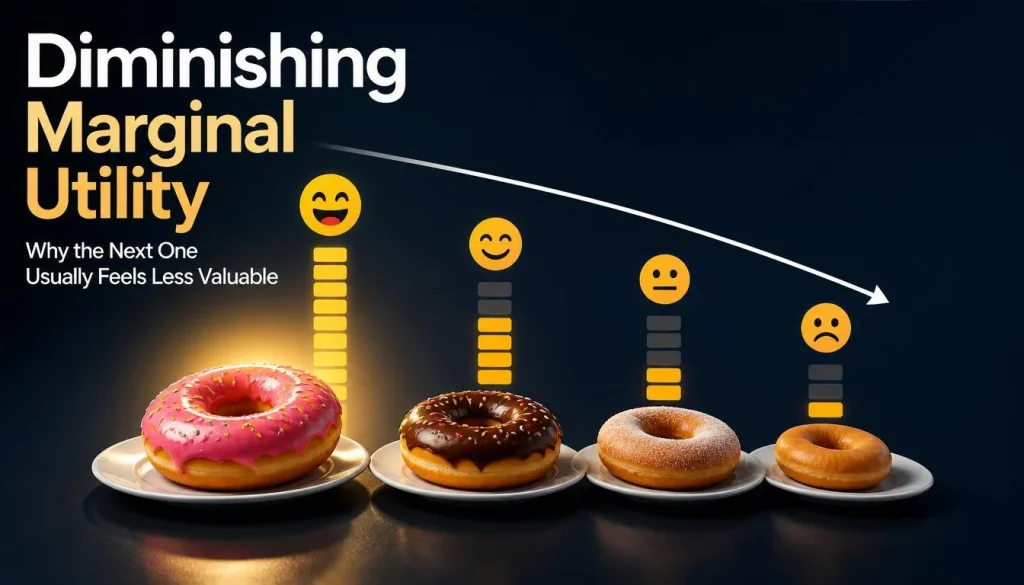
Diminishing marginal utility describes a common pattern: as a person consumes more units of the same good or experience, the additional satisfaction from the next unit often becomes smaller. The first glass of water when you are thirsty can feel extremely valuable; the fifth may add very little.
The idea does not say that total satisfaction must immediately fall. Total utility can keep increasing while each extra unit adds less than the previous one. That distinction is central to understanding consumer choice.
Marginal Utility Means the Value of the Next Unit
Economists use ‘marginal’ to mean an additional unit. If the first slice of pizza gives 20 units of satisfaction, the second adds 15 and the third adds 8, marginal utility is declining even though total utility rises from 20 to 35 to 43.
The concept focuses on the change created by one more unit, not the total value of everything already consumed.
Total Utility Can Rise While Marginal Utility Falls
Suppose total utility from one, two, three and four units is 20, 35, 43 and 47. Marginal utilities are 20, 15, 8 and 4. The person is still better off after the fourth unit than after the third, but the gain is smaller.
Only when marginal utility becomes negative does an extra unit reduce total utility. Eating beyond comfort is a simple example.
Scarcity Helps Explain the Pattern
When a good is scarce relative to a person’s need, the first unit is often assigned to the most important use. Additional units satisfy progressively less urgent uses.
Water illustrates the logic. The first liters may be used for drinking, later units for cooking, cleaning or gardening. The value of the next unit depends on what need remains unsatisfied.
Income and Context Can Change Utility
Marginal utility is not fixed across people or situations. A bottle of water may be extremely valuable during a hike and ordinary at home. The same restaurant meal can feel valuable when hungry and unnecessary after eating.
Preferences, income, timing, location and alternatives all change the usefulness of the next unit.
Why the Law Is Not a Perfect Mechanical Rule
Some goods become more useful when combined. The second shoe of a pair may add more value than the first because a single shoe has limited use. Collections, network products and learning can also produce increasing value over some range.
Diminishing marginal utility is therefore a useful tendency, not a universal law that applies identically to every product from the first unit onward.
Price Decisions Happen at the Margin
A consumer deciding whether to buy one more unit compares the expected benefit of that additional unit with its price and with other uses of money.
If the next unit provides little value relative to its price, the consumer stops. This helps explain why demand curves often slope downward: lower prices can make additional units worthwhile.
A Simple Consumer Choice Example
Imagine apples cost 2 each. The buyer values the first at 6, the second at 5, the third at 3, the fourth at 2 and the fifth at 1. At a price of 2, the first four may be worth buying, but the fifth is not.
If the price falls to 1, the fifth unit may now be purchased. The change in quantity demanded comes from comparing marginal value with market price.
Bulk Discounts Exploit the Same Psychology
‘Buy four, pay for three’ can look attractive because the average price per unit falls. But the relevant question is whether the household actually values the fourth unit enough to use it.
If extra units expire, create storage cost or encourage unnecessary consumption, the nominal discount does not create real savings.
Subscription Plans Can Hide Low Marginal Use
A household may pay for multiple streaming, software or gym subscriptions because each service sounded useful when purchased. Over time, the marginal value of additional subscriptions can become very small.
Reviewing actual use rather than the number of features helps identify whether the next subscription still creates enough benefit.
Marginal Utility and Budget Allocation
Consumers do not maximize satisfaction from one product alone. They allocate limited income across food, housing, transport, entertainment and saving.
A simple economic idea is to compare marginal utility per unit of price. Spending tends to shift toward the option that provides more additional value for each unit of money until trade-offs become more balanced.
Why Income Has Diminishing Marginal Utility Too
An extra 1,000 of income can transform the life of someone who cannot cover basic necessities, while the same amount may have little effect on a wealthy household’s consumption possibilities.
This intuition is one reason economists distinguish changes in absolute income from changes in welfare. Money’s usefulness depends partly on the resources already available.
Diminishing Utility Is Not the Same as Boredom
Boredom can reduce the value of repeated consumption, but diminishing marginal utility is broader. Even without boredom, the most urgent need may simply be satisfied first.
The concept also applies within a short period. The first warm coat has far greater practical value than a tenth similar coat even if the owner still likes coats.
Businesses Use Marginal Value in Pricing
Quantity discounts, product bundles and tiered plans try to capture customers with different marginal valuations. A basic package may satisfy the most important need, while premium features target customers who value additional functionality.
Good pricing design recognizes that not every additional unit or feature has the same value to every buyer.
The Idea Helps Explain Consumer Surplus
If a buyer would have paid 6 for the first unit but market price is 2, the difference represents part of consumer surplus. Later units usually have smaller valuation gaps as marginal utility declines.
Total consumer surplus is built from the difference between willingness to pay and actual price across the units purchased.
Practical Questions Before Buying More
Do I already own enough to satisfy the main need? Will the extra unit actually be used? Does buying more create storage, maintenance or expiry cost? Is the discount encouraging quantity rather than genuine value?
These questions translate marginal utility from an abstract concept into everyday budgeting.
The Next Unit Is the Decision That Matters
Diminishing marginal utility is fundamentally about the value of one more unit. The first units often satisfy the most urgent needs; later units tend to serve less important uses.
Understanding that pattern helps explain demand, discounts, budgeting and why ‘more’ does not always mean proportionally more value. Good decisions compare the benefit of the next unit with what must be given up to obtain it.
Marginal Utility Helps Explain Why Demand Slopes Down
Suppose the first unit is worth 10 to a buyer, the second 8, the third 6 and the fourth 4. At a market price of 7, only the first two units create enough value to justify purchase. If the price falls to 5, the third unit becomes attractive as well.
This does not prove every real demand curve comes only from diminishing marginal utility, but it provides an intuitive link between falling marginal value and higher quantity demanded at lower prices.
Choice Depends on Opportunity Cost
Buying one more unit means giving up something else that the money could purchase. Even if the additional unit provides positive utility, it may not be the best use of limited income.
That is why a consumer can stop buying before marginal utility reaches zero. The relevant comparison is marginal benefit versus price and the value of the next-best alternative.
Time Can Reset Marginal Utility
Utility can fall within a consumption period and recover later. The fourth coffee in one morning may have little value, while the first coffee the next day can again feel highly valuable.
This is important when applying the concept to recurring purchases. The relevant unit is often ‘one more right now,’ not ‘one more at any point in life.’
Digital Goods Challenge the Simple Quantity Story
An extra copy of a digital file may have almost no production cost and almost no additional value to the same user. By contrast, an extra user on a social network can increase value for existing users because of network effects.
Modern products therefore remind us that marginal utility interacts with product design, complementarity and social use rather than following one mechanical shape.
The Concept Also Helps Explain Variety Seeking
After consuming several units of the same product, the next unit of a different product may provide more marginal utility. A person may choose fruit after several slices of pizza even if they still like pizza.
This helps explain why consumers diversify baskets rather than spending all discretionary income on the single product they enjoy most.
Businesses Should Not Assume Customers Always Want Larger Packs
Large packages lower unit cost, but households with limited storage or uncertain usage may prefer a smaller pack at a higher unit price.
Product-size strategy therefore reflects both production economics and customers’ declining marginal value for additional quantity.
Use Marginal Thinking Instead of Average Thinking
A household may say a six-pack costs less per unit than buying two items separately. That average-price statement is true but incomplete. The decision should focus on the extra four units: what additional value do they provide and what extra amount must be paid?
Marginal thinking prevents a low average price from justifying unnecessary quantity.